


Aiden Blake submitted this interesting video to Latest Sightings.
Rare sighting
While driving along a road parallel to a river, Aiden was delighted to encounter a rare black rhinoceros. According to a 2022 census, there are just over 200 of these rare beasts in the Kruger National Park.
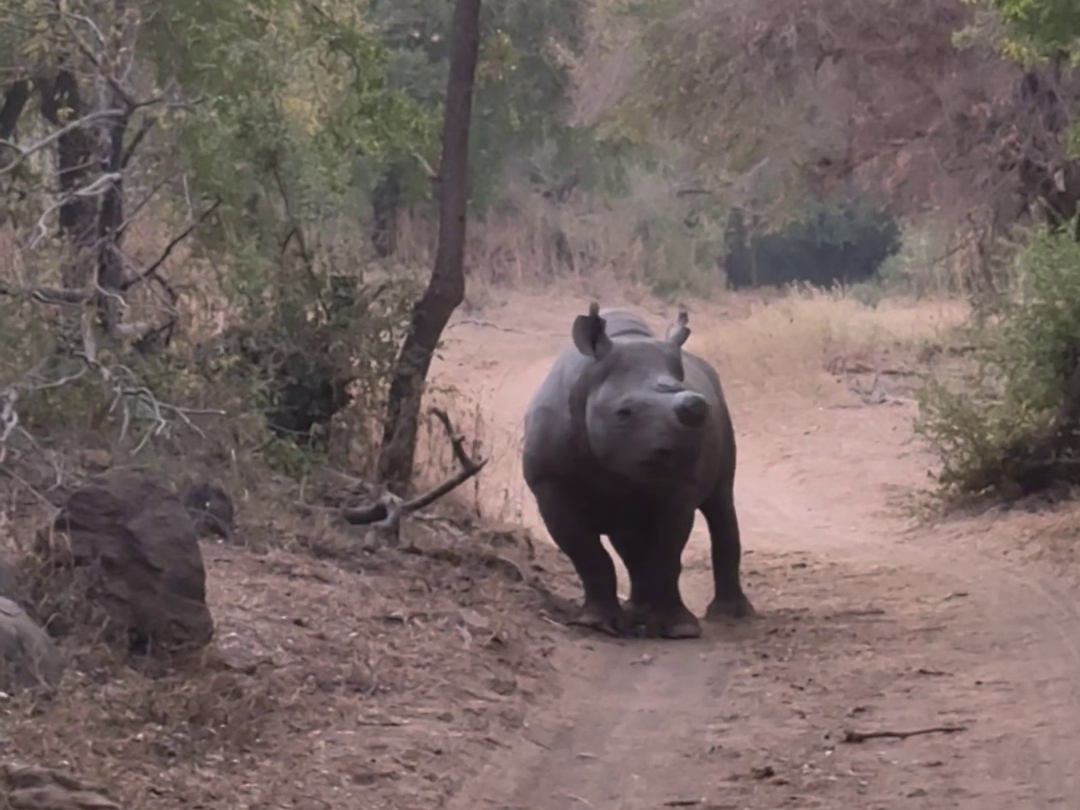
Known for their occasional belligerence, Aiden waited quietly for the 800 kg beast to make its next move.
Down the riverbank
Opting to avoid confrontation, the rhino detoured off the road and made its way down the riverbank. Then, to Aiden’s surprise, the rhino did something unexpected.
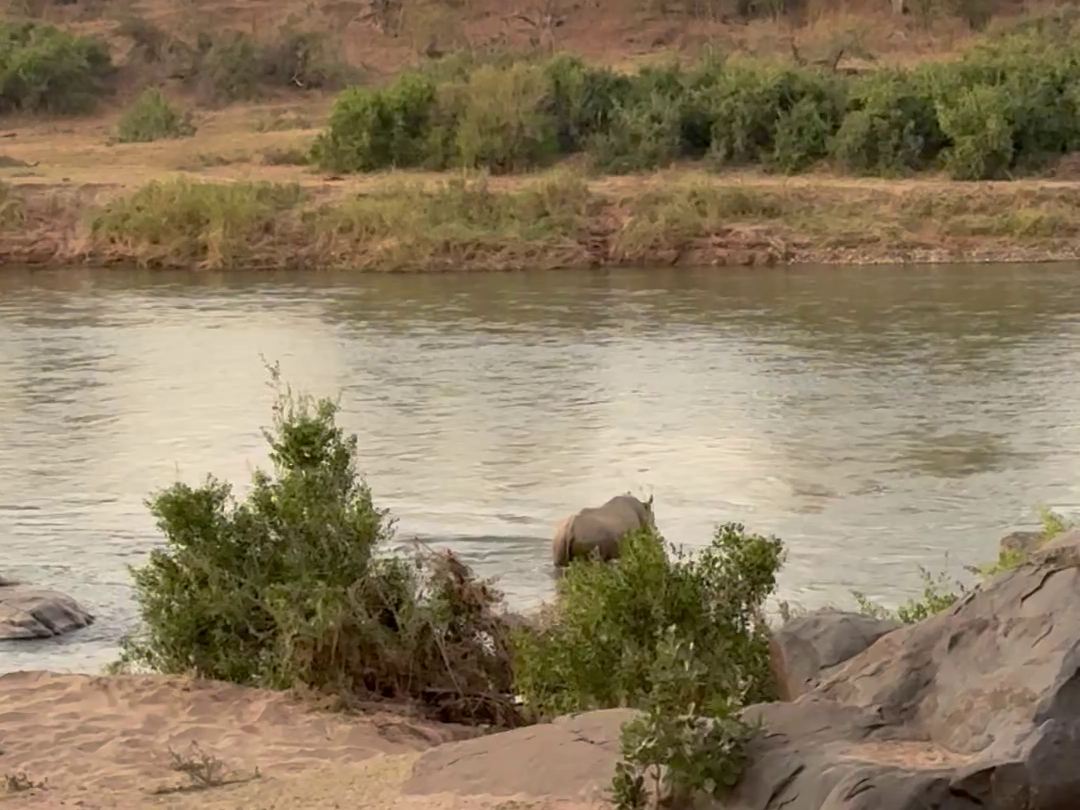
Without hesitation, the rhino waded into the swiftly flowing river.
Now, rhinos love nothing better than to cool themselves off in water. However, this is normally witnessed in the confines of a mud wallow. So, seeing this unusual behaviour made an already special sighting all the more memorable.
Forging ahead
Unlike white rhinos, whose heads are held close to the ground, black rhinos hold their heads more horizontally to their bodies.

This meant that the rhino could easily keep its head above the waterline as it moved ahead.
Dehorned
As it wades through the current, we note that it does not have the typical sharp pointed horn we’d expect.

This is an unfortunate by-product of the poaching scourge that has nearly caused the demise of the species across Africa.
To deter poaching, authorities have decided to dehorn all the rhinos in the park.
Second thoughts?
After making it about two-thirds of the way across the river, it seems for a moment as if the rhino feels it is about to get in over its head.

Consequently, it begins to turn, as if it is about to make its way back to the near shore. Turning a full 180-degrees, the rhino seems intent on retracing its steps.

Get our Best Sightings as they Come in
Safely across
However, it then seems to reconsider once again, and duly made its way safely to the far bank.

There it found itself faced with another challenge. The embankment on the far side was quite steep in places.

Consequently, the rhino took a while before finally navigating a safe route up onto the riverbank. At last, the rhino could relax.
As Aiden watched, he was grateful to have witnessed this rare behaviour from an incredibly rare and special creature.
Differentiating black and white rhinos
Although similar at a glance, white and black rhinos have several differences. Firstly, we should point out that black and white do not refer to their colour.
‘White’ is a corruption of the Dutch word ‘wijd’, meaning wide, used in reference to their wider, square-lipped mouths. White rhinos only eat grass.
By contrast, black rhinos have a hooked lip, used for browsing leaves.
Black rhinos are significantly smaller than whites, tipping the scales at 800–1,400 kg (1,760–3,080 lb), compared to 1,800–2,500 kg (3,968–5,512 lb).
Lastly, as mentioned, black rhinos hold their heads up, suitable for browsing from trees and bushes. By contrast, white rhinos hold their heads low to accommodate grazing on grass.
N.B.
Due to the threat from poachers, please remember not to include any location data should you wish to share your pictures of rhinos on social media.


