

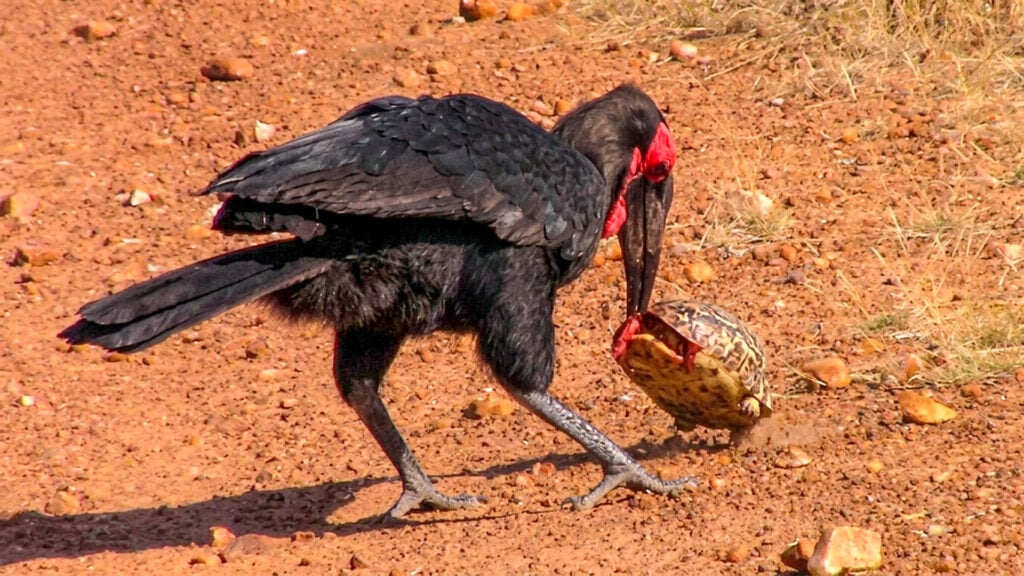
Southern ground hornbills, despite their ungainly appearance, are voracious predators. In this video, a greedy individual devours a tortoise while its family waits.
The photographer filmed the footage at an undisclosed location in South Africa’s Kruger National Park.
A special sighting
As we join the action in the video, we see a large black bird probing at something. On its own, the bird is a special sighting.
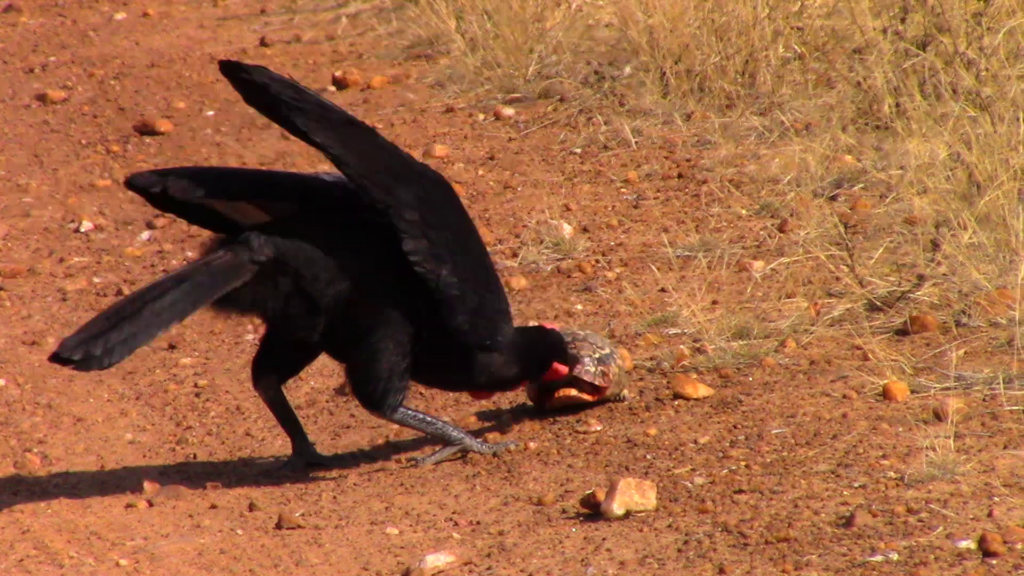
Known as a southern ground hornbill, the bird is classified as vulnerable by CITES. Their range extends from northern Namibia and Angola to northern South Africa and southern Zimbabwe to Burundi and Kenya.
Already dead
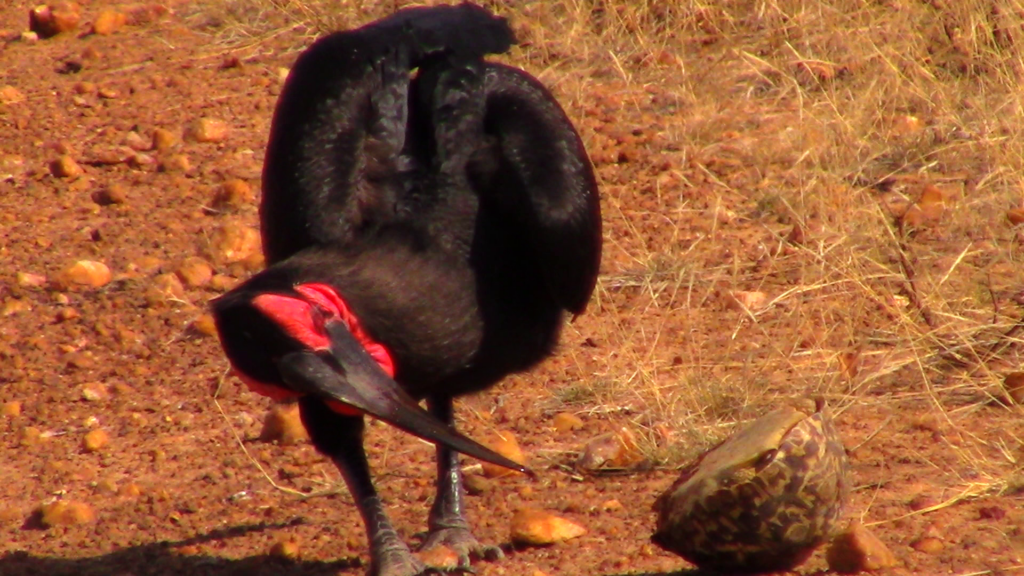
As the camera zooms in, we see that the hornbill is feeding on a leopard tortoise. Visitor most commonly sight this species in the Kruger Park.
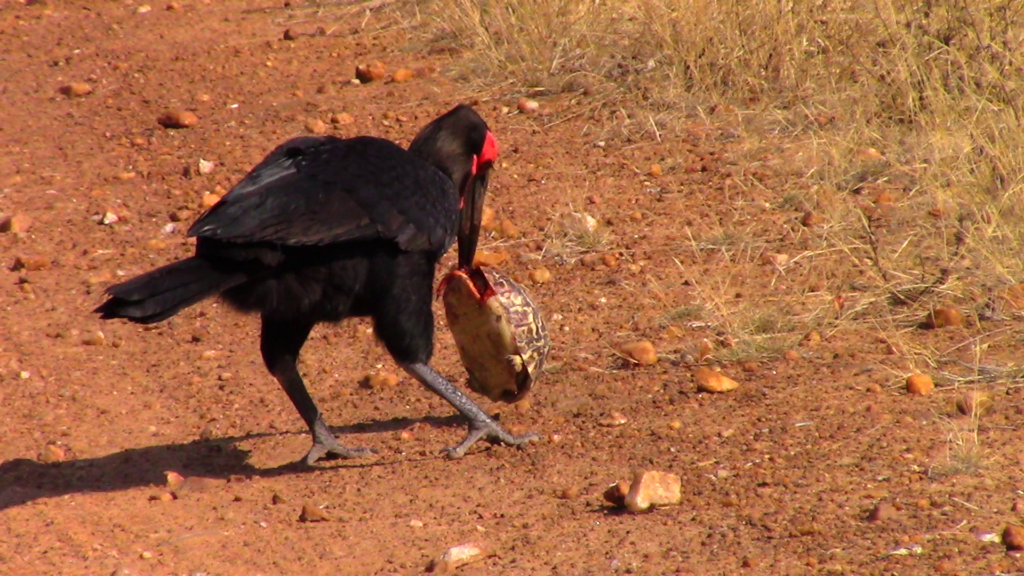
Sadly for this one, however, it is already dead. Presumably, the hornbill killed it and appears to have already eaten the head and front legs.
Right tool for the job
However, there is still a lot of meat to eat. The only problem is that the tortoise’s hard shell, or carapace, conceals it.
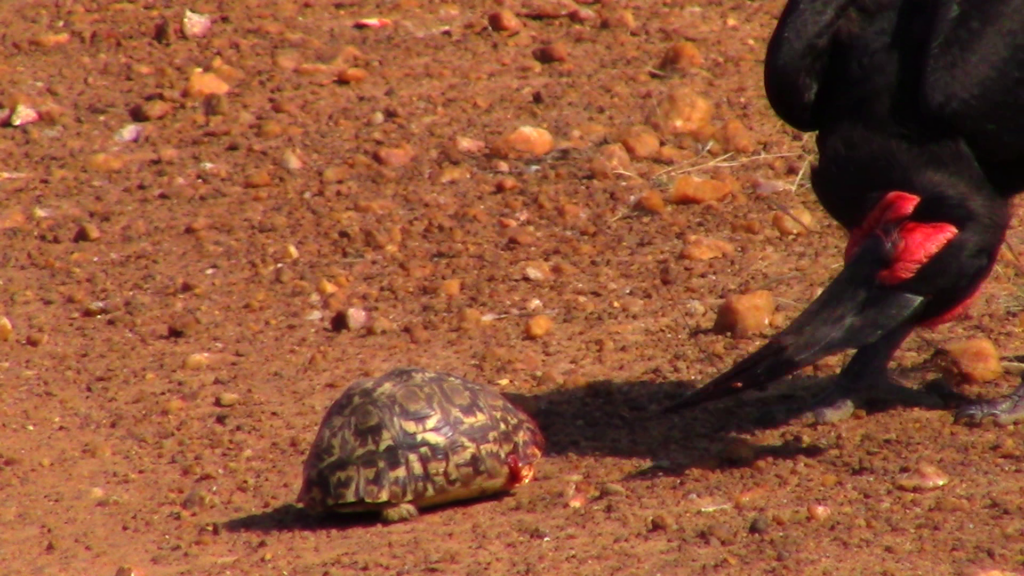
Accordingly, the bird examines all the angles. Since the shell is evidently too hard for the hornbill to penetrate, its only option is through the opening left where the head and legs once were.
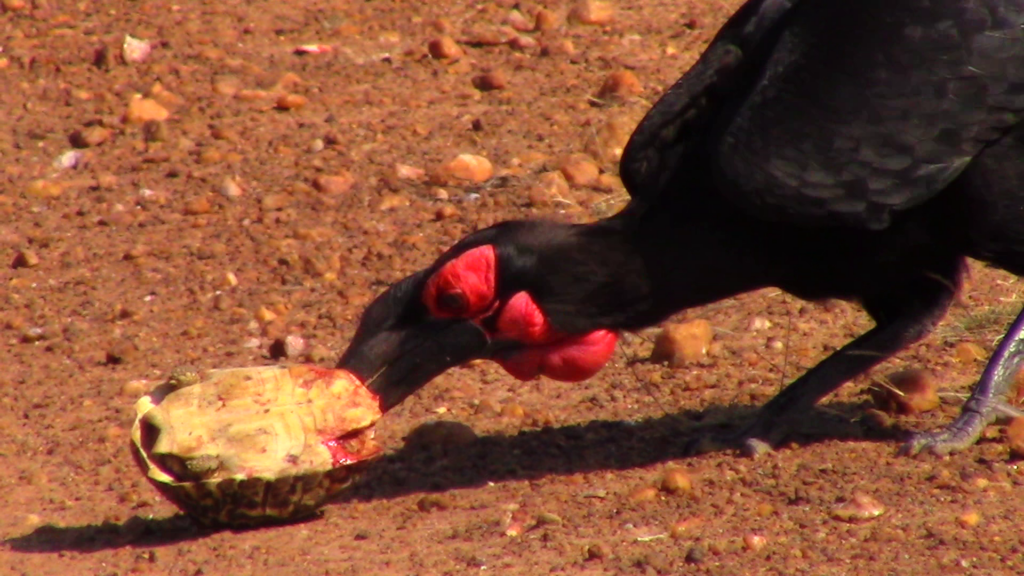
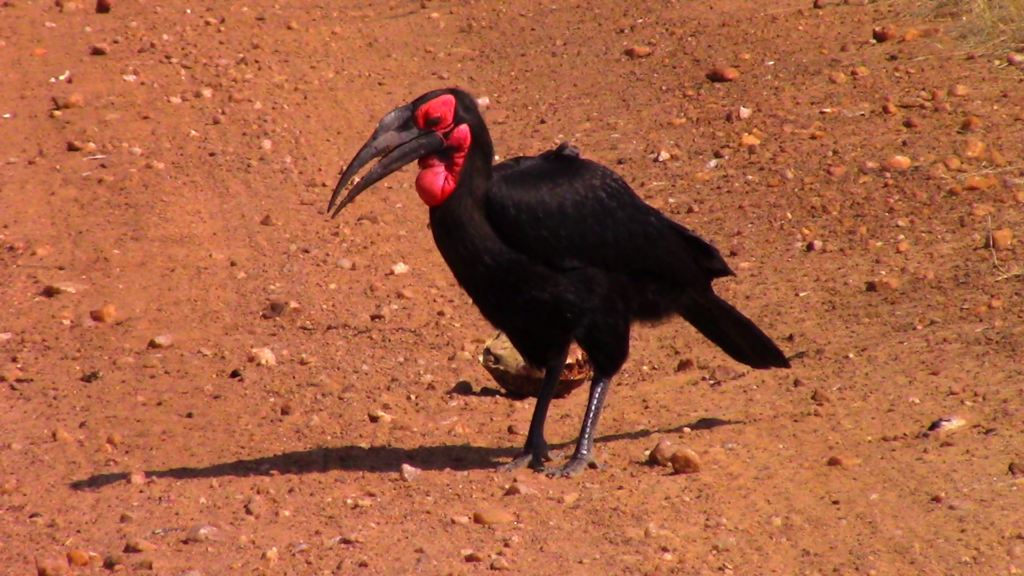
Thankfully, the bird has exactly the right tool for the job. Delicately, it inserts its long, curved bill into the opening.
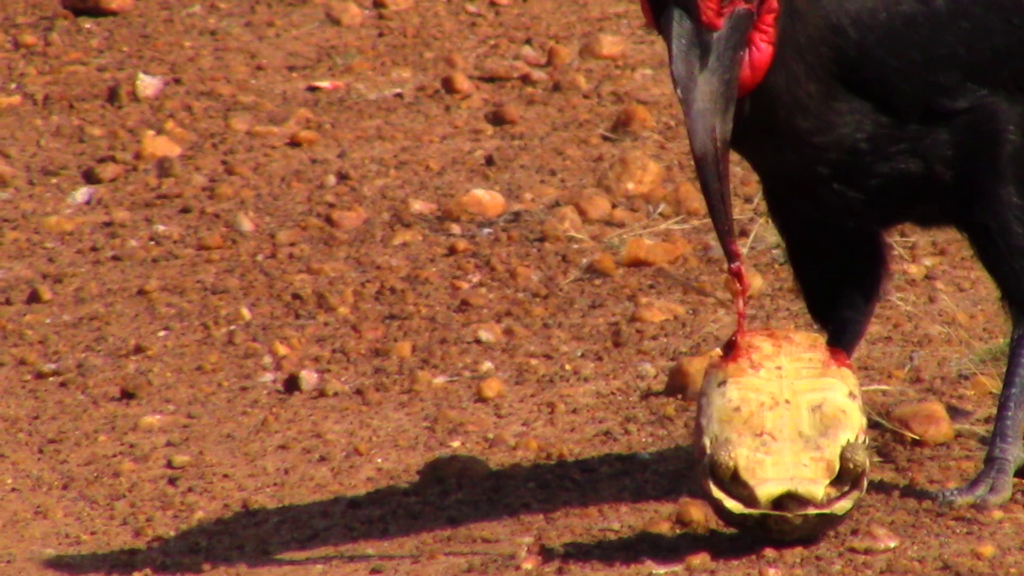
Moments later, it withdraws with a piece of flesh clamped in its beak. At this rate, it might take a while to finish its meal.
Easily identified
People sometimes mistakenly call ground hornbills “turkey buzzards”. However, the only similarity is their approximate size.
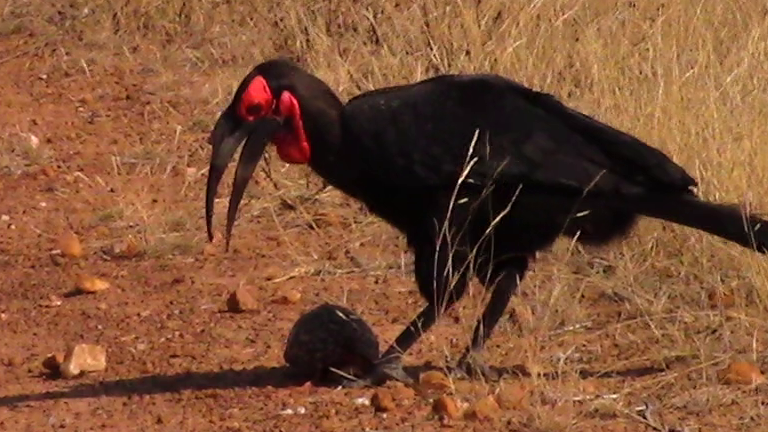
That said, they are easily distinguishable. Not only are their beaks instantly recognisable, but the adults also have bold, red facial skin. And, if you look closely, eyelashes that would make a supermodel blush.
Get our Best Sightings as they Come in
Family waiting
Now, you might think this is one lucky hornbill to have the tortoise all to itself. However, that doesn’t tell the whole story.
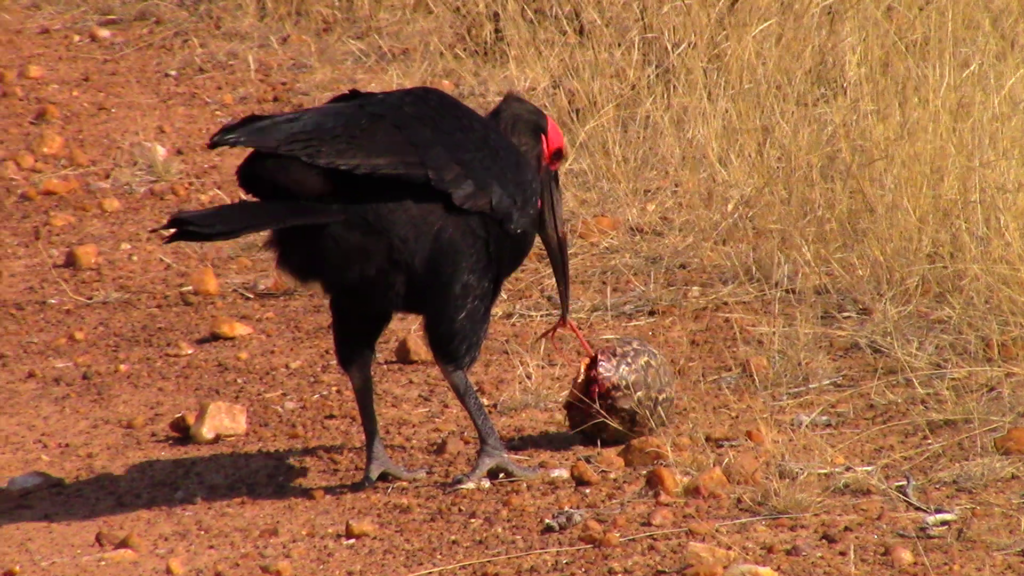
For nearby, its mate and a sub-adult chick are seen waiting. The chick, on the right, already has red facial skin, a sign that it is over six years old. Hornbill chicks stay with their parents for up to two years, longer than any other bird.
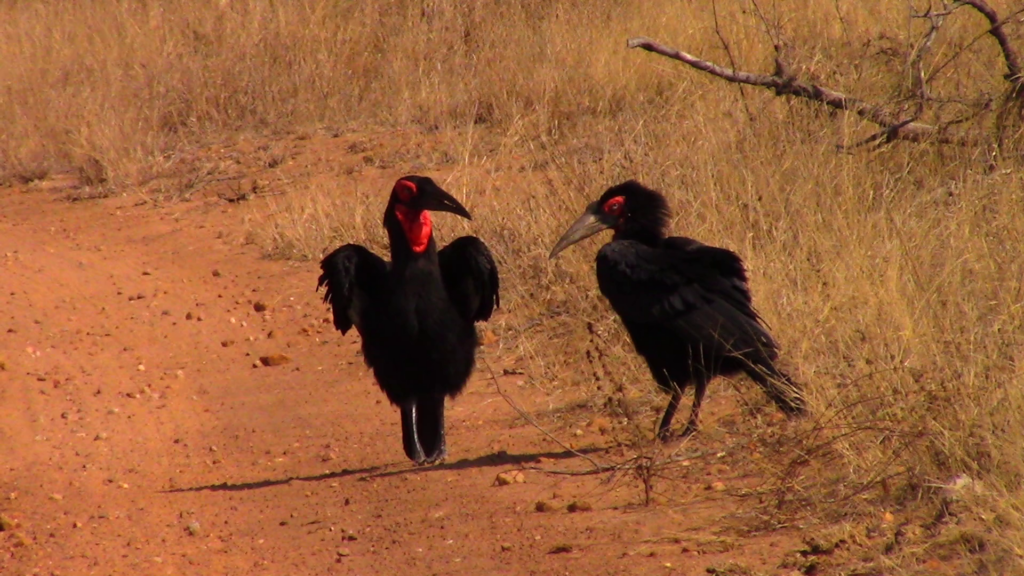
Ground hornbills are one of the few birds termed obligate cooperative breeders. This means that several birds will assist the mating pair in raising their young.
Research suggests that only birds that have helped raise six clutches will themselves be allowed to breed.
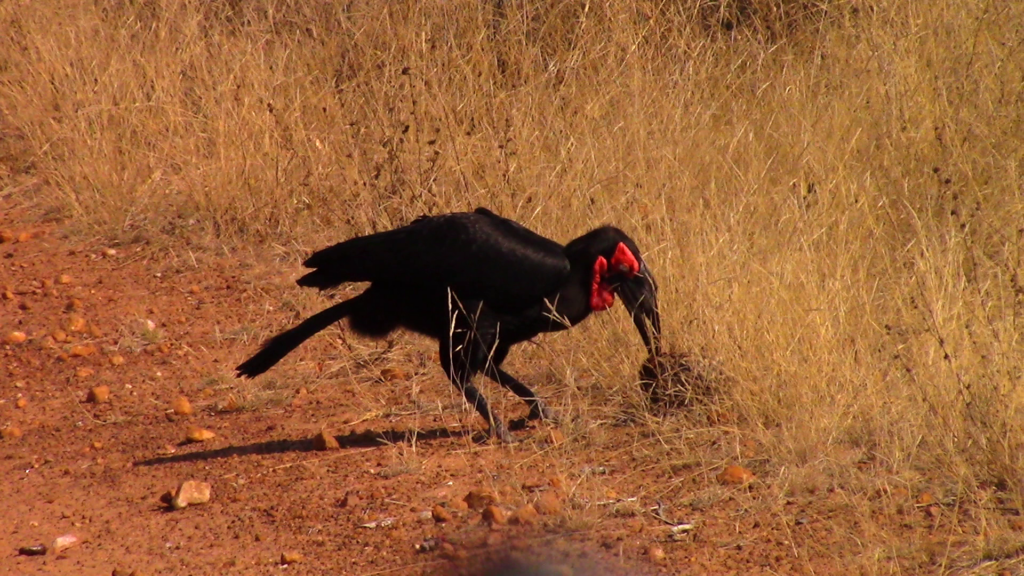
Subsequently, as we return to the feeding bird, it is evident that while parenting duties are shared, the same cannot be said for the tortoise. It is not clear why the other birds stay away.
Carnivorous diet
Consequently, the bird takes its sweet time trying to find the tastiest morsels. A ground hornbill’s diet is strictly carnivorous.
They also feed on reptiles, frogs, snails, insects, and mammals up to the size of hares. Strangely, they seldom drink.
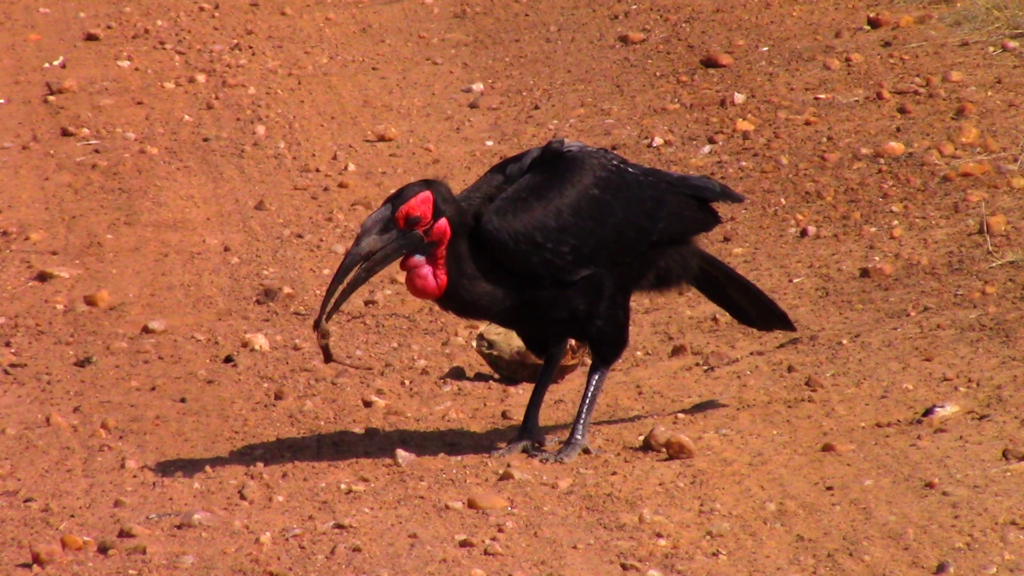
Little by little, the bird extracts the tortoise’s innards. Each morsel is carefully held in the tip of the bill.
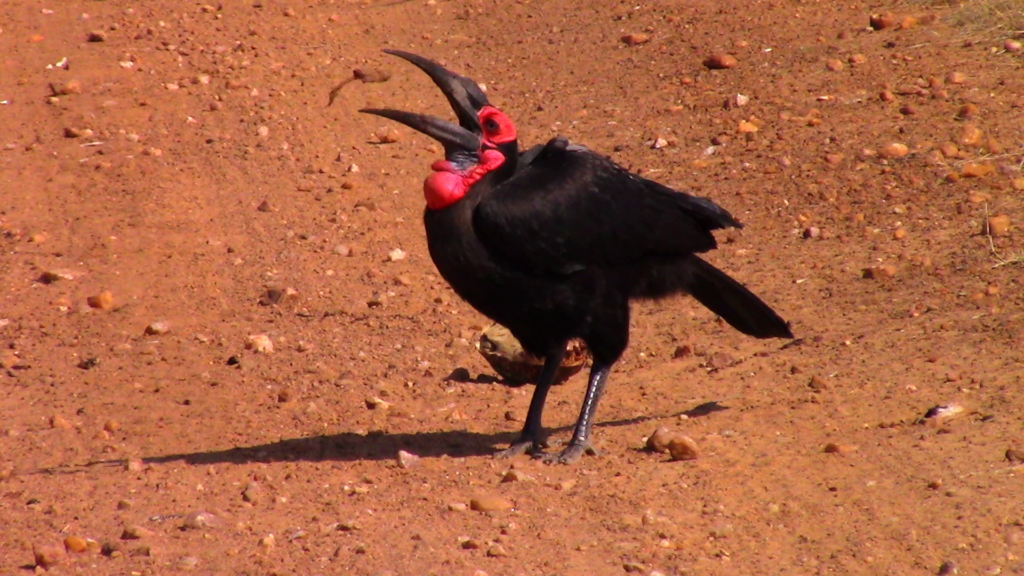
Then, with practiced efficiency, it throws it into the air before catching and swallowing it.
Report sightings
Should you be fortunate enough to spot southern ground hornbills, you can do your bit for their conservation by reporting the sighting here.


