

A Tense Moment on the Dirt Road
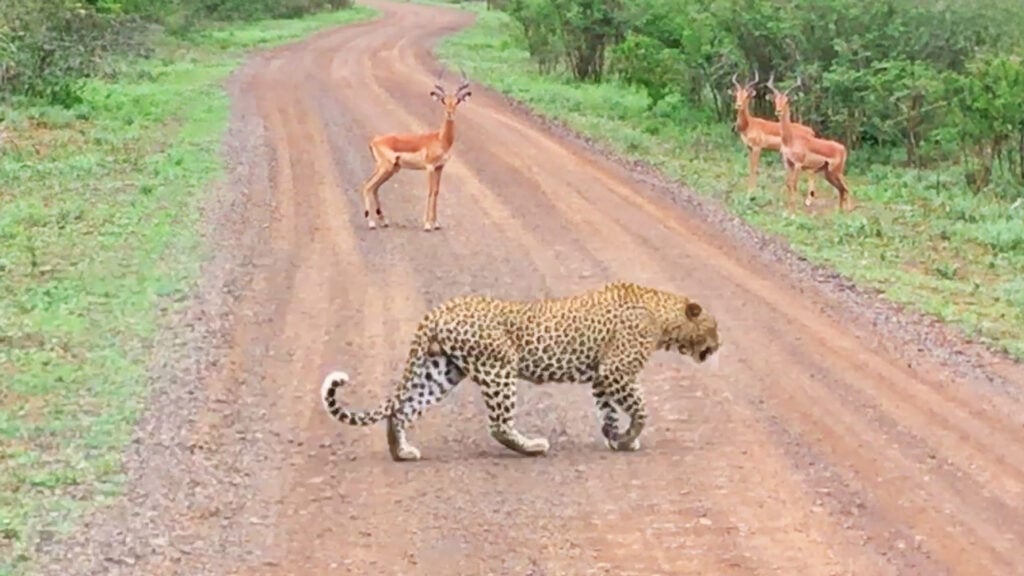
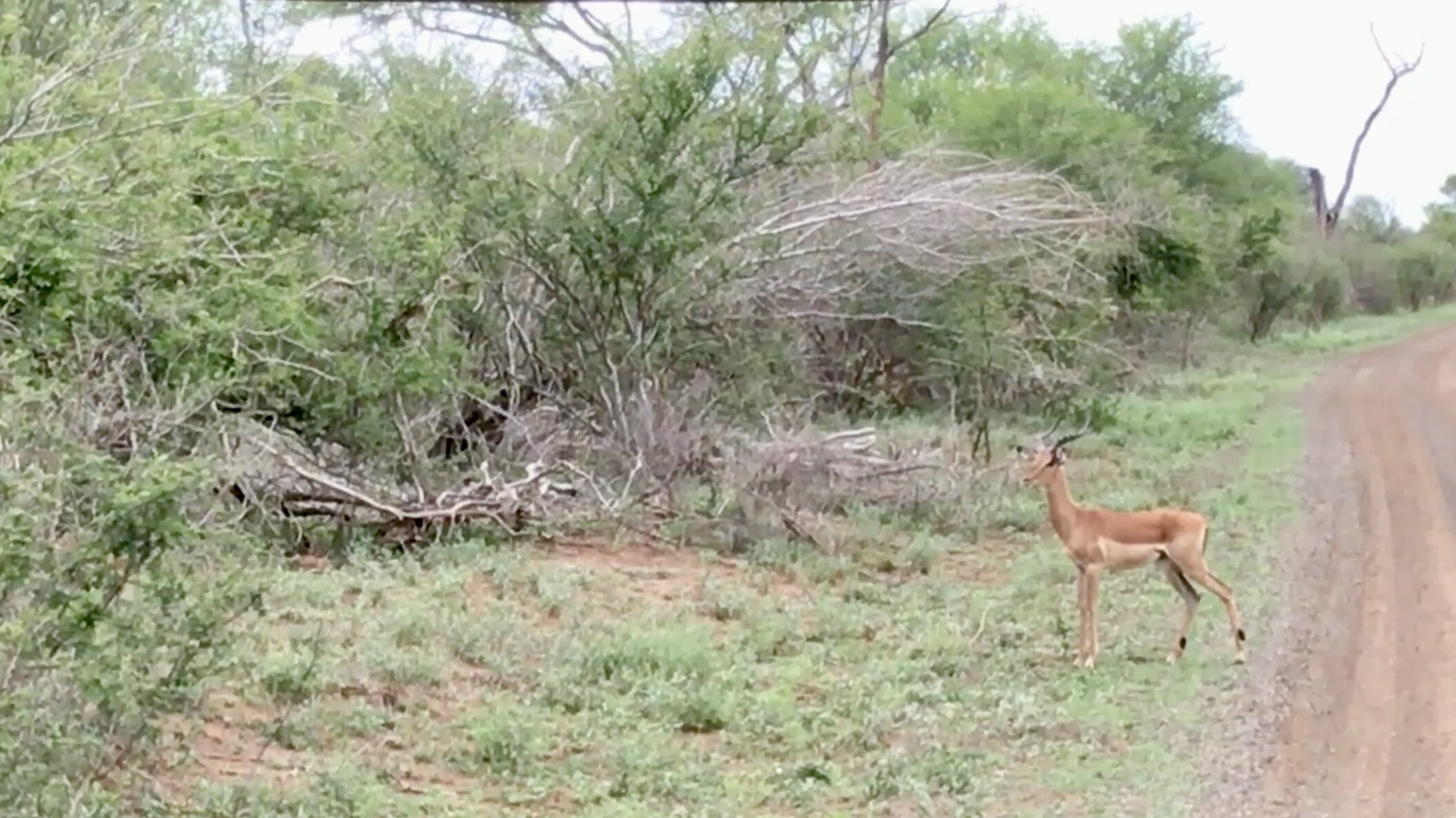
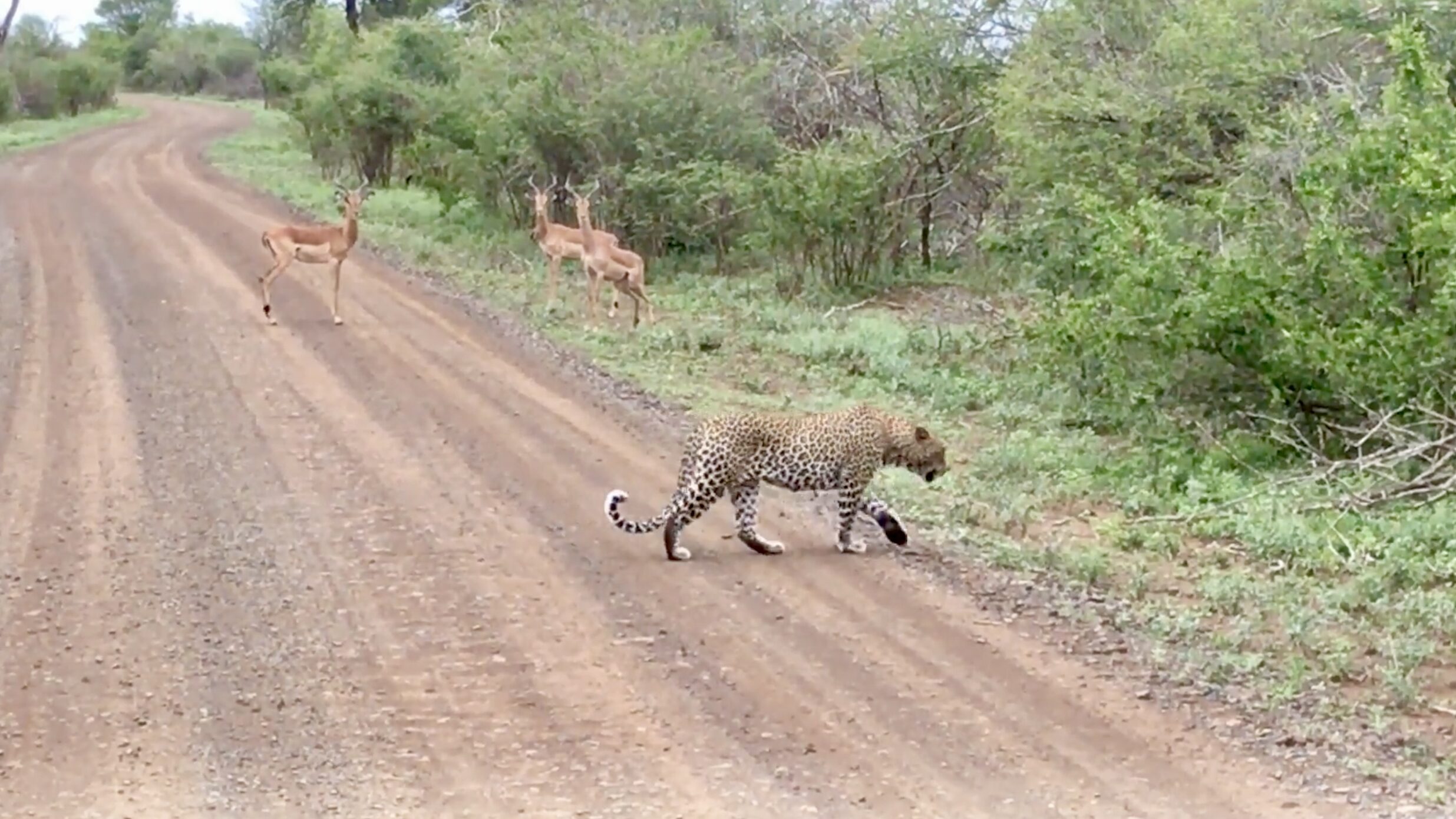
On a quiet day in Kruger National Park, safari-goer Gaurav Mishra captured a brief but tense interaction between predator and prey. His video begins with an impala standing rigidly in the middle of a dirt road, ears pricked, and muscles taut.
The impala emits small vocalizations, signalling distress and alerting its nearby companions. Meanwhile, its gaze is fixed on the bushes at the side of the road, searching for the source of the perceived threat.
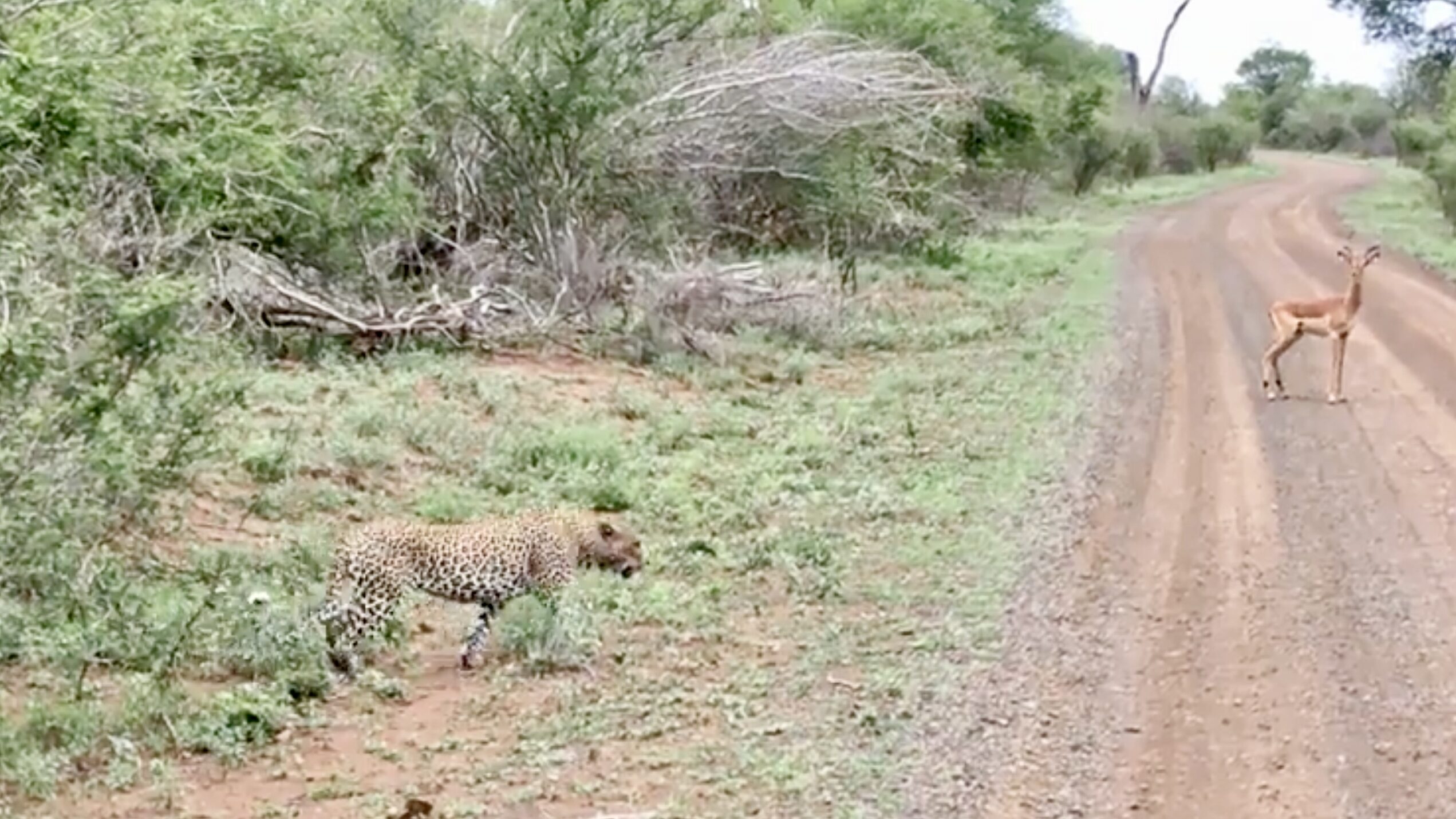
As the camera pans slowly to the left, a leopard emerges from the bushes, moving with its characteristic stealth and grace. As the cat steps onto the road, it pauses briefly, seemingly taking note of the vehicle full of humans, before continuing its casual crossing.

Surprisingly, the leopard never so much as glances directly at the impalas. It walks past them as if completely unaware of the meal standing directly before it.
Impalas on Edge
As Gaurav’s camera follows the leopard’s crossing, two more impalas are revealed on the other side of the road. They stand perfectly still, eyes locked on the leopard, seemingly ready to flee at a moment’s notice.
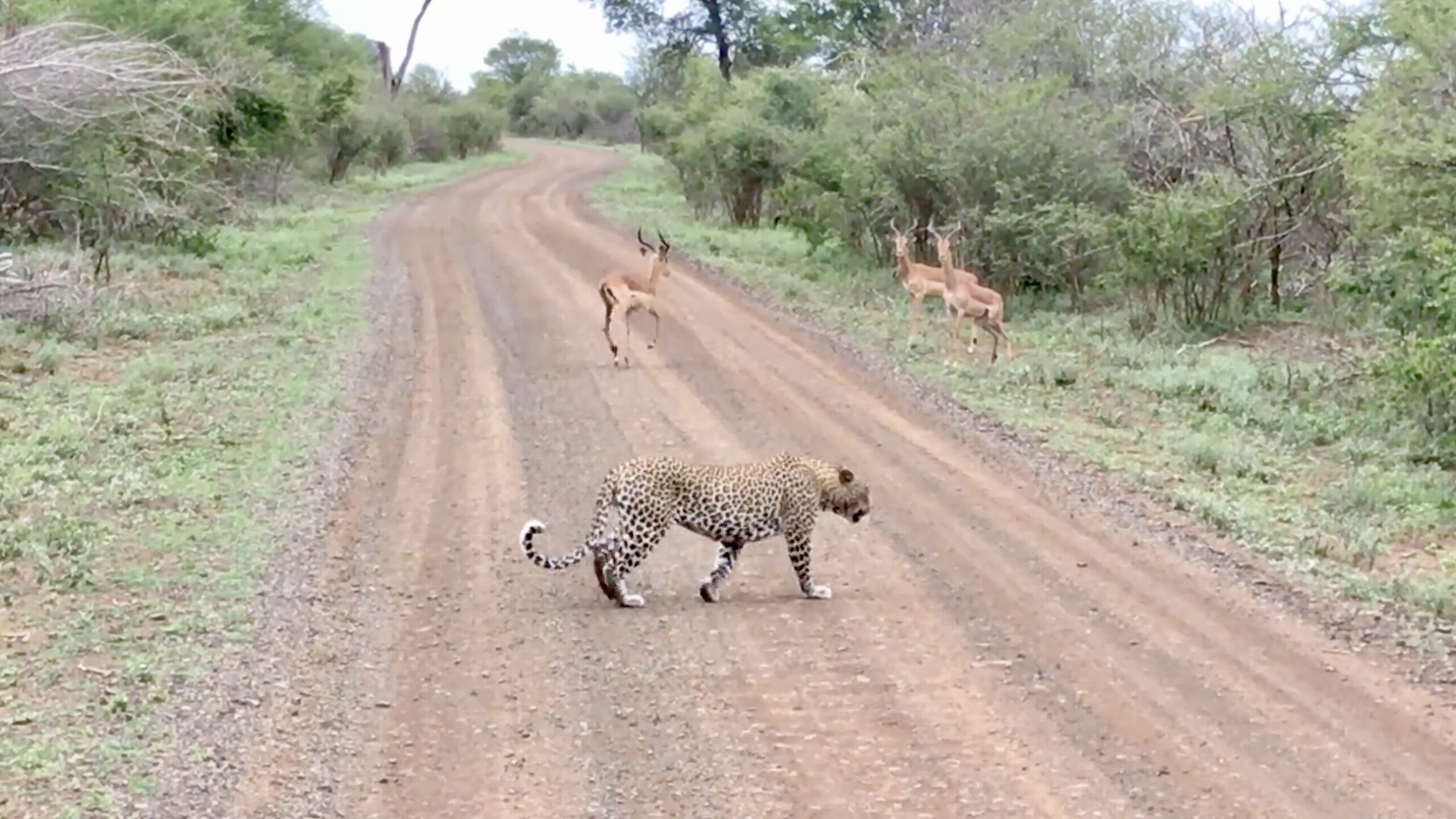
The first impala, initially standing alone, spooks slightly and retreats toward its companions, seeking the reassurance of proximity to the group. Even without direct confrontation, the scene perfectly demonstrates the tension and constant alertness that prey animals live with on a daily basis.
Frozen in Place
This behaviour is not just dramatic for viewers; it is a sophisticated survival strategy known as “freezing” or tonic immobility. When prey detect a predator, remaining motionless can reduce the likelihood of their detection, particularly by predators like leopards that rely heavily on movement to locate and target their prey.
Freezing is an energy-efficient response compared to fleeing immediately, especially when the predator’s intentions are unclear. It buys the prey time to assess the threat and determine whether flight is even necessary.
Physiologically, freezing is accompanied by elevated heart rate and adrenal responses, preparing the animal to take quick action if the predator does decide to strike. In addition to visual camouflage, freezing also works in tandem with alarm calls and social coordination.
Impalas are highly social animals that rely on group vigilance; by remaining frozen and alert, an individual not only protects itself but also communicates risk to nearby herd members. In this encounter, the first impala’s initial distress vocalizations likely alerted the others, allowing them to prepare for the threat.
A Predator’s Calm Composure
Leopards are master strategists, relying on stealth, patience, and energy efficiency rather than brute force alone. Unlike lions or cheetahs, leopards often ignore potential prey that is not immediately accessible or worth the effort.
Get our Best Sightings as they Come in
In this instance, the leopard moved with deliberate calm, demonstrating that not every sighting of prey leads to a chase. This restraint reflects an advanced level of behavioural adaptation, where risk, energy expenditure, and opportunity are all balanced together.
A Lesson in Wildlife Awareness
Even brief encounters like this offer a window into the delicate predator-prey dynamics that govern African savannas. The impalas’ frozen vigilance and the leopard’s nonchalant stride illustrate that survival often hinges on subtle cues and measured reactions, not always high-speed drama.

In the wild, moments that appear uneventful can teach us a lot. For these impalas, freezing was an instinctive, effective response to a potential threat, while the leopard’s calm composure reminded us that predators don’t always act on opportunity.
Sometimes a quiet, tense standoff is all it takes to survive another day.


