

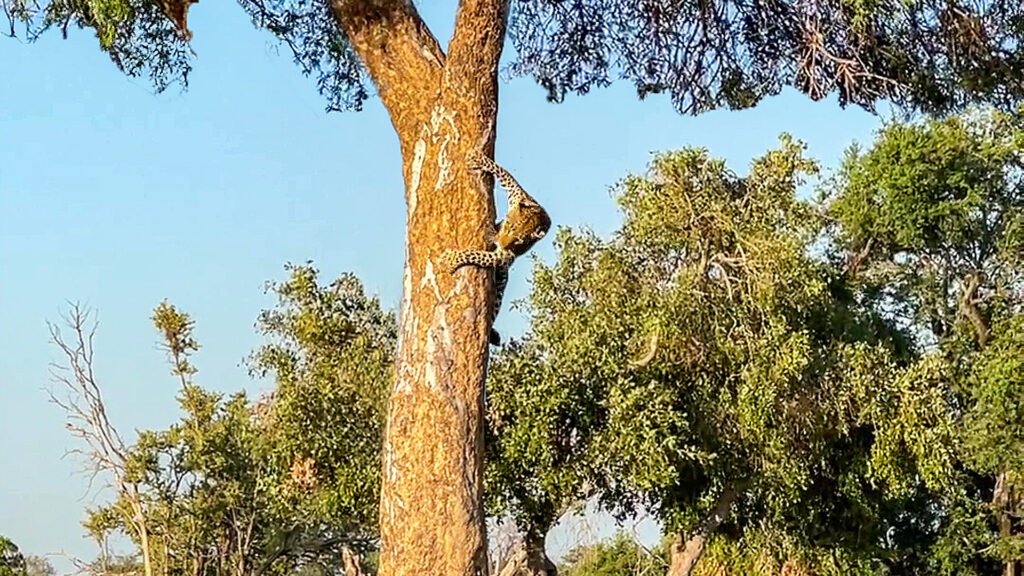
Wesley Hartmann sent this short video to Latest Sightings. He filmed it while on safari in Botswana’s Okavango Delta.
Leopards love trees
What sets leopards apart from other big cats like lions and cheetahs is the ease with which they climb trees. Short limbs tipped with long claws and a powerful, agile physique let them make tree climbing look easy.
However, the same cannot always be said when it is time for them to descend. With gravity and awkward angles conspiring against them, getting down is not always an elegant affair.
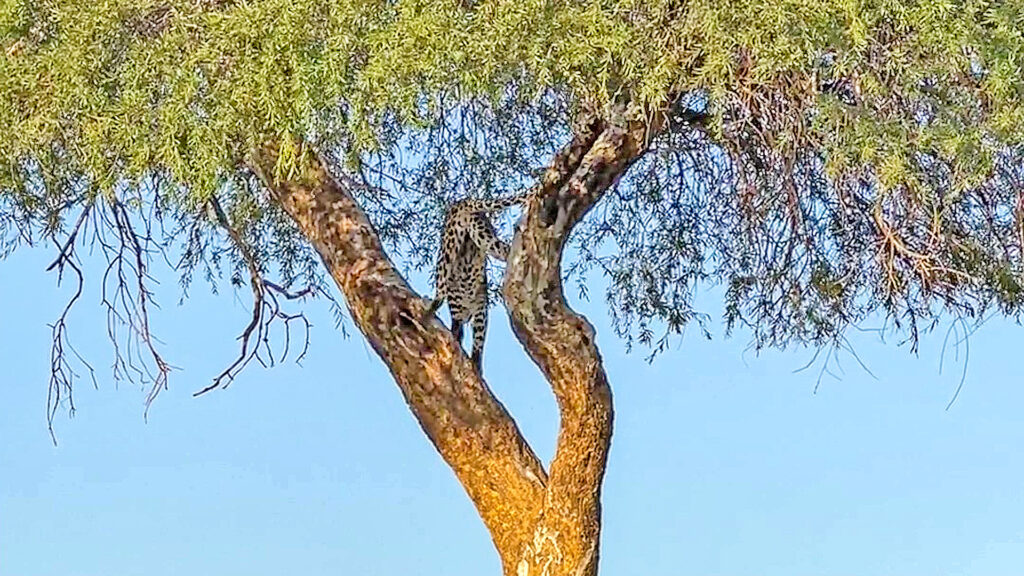
As we join the action in the video, we see a leopard emerging from the canopy, making its way to a fork high up the tree’s trunk.
Watch the sighting here:
Power and flexibility
Among the things that make leopards better climbers than, say, lions, is their paws. Compared to lions, their paws are highly flexible, allowing them to grip around objects.
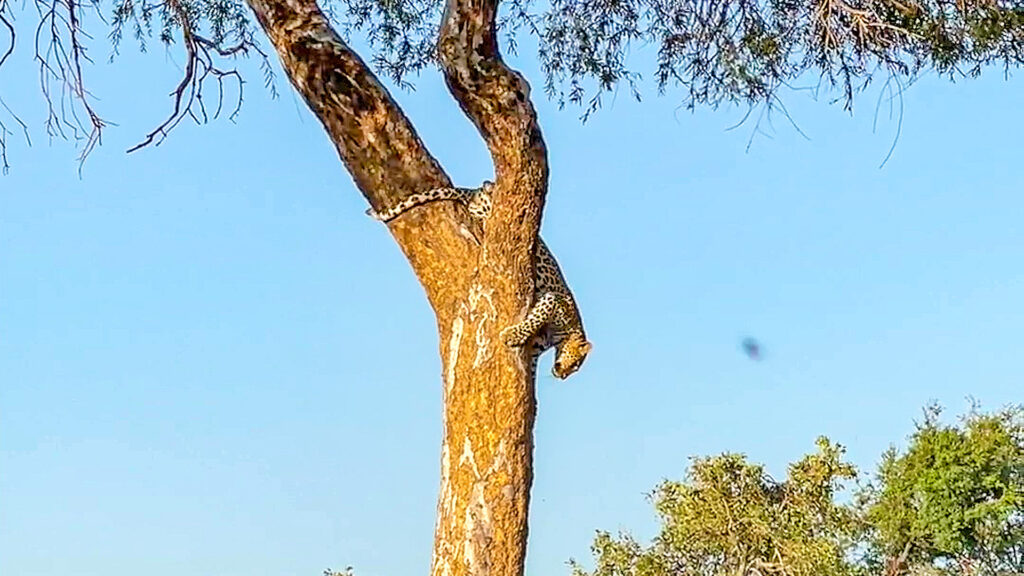
Additionally, they are extremely flexible, able to contort their bodies while still maintaining muscular control.
Without hesitating, the leopard uses its hind legs to anchor itself in the fork while it inches its upper body downwards. All the while, its claws stay embedded in the soft bark.
Point of no return
Pulled by gravity, it looks like the leopard’s next move is to pivot its body around, so that it can anchor itself with its front paws for a reverse descent.
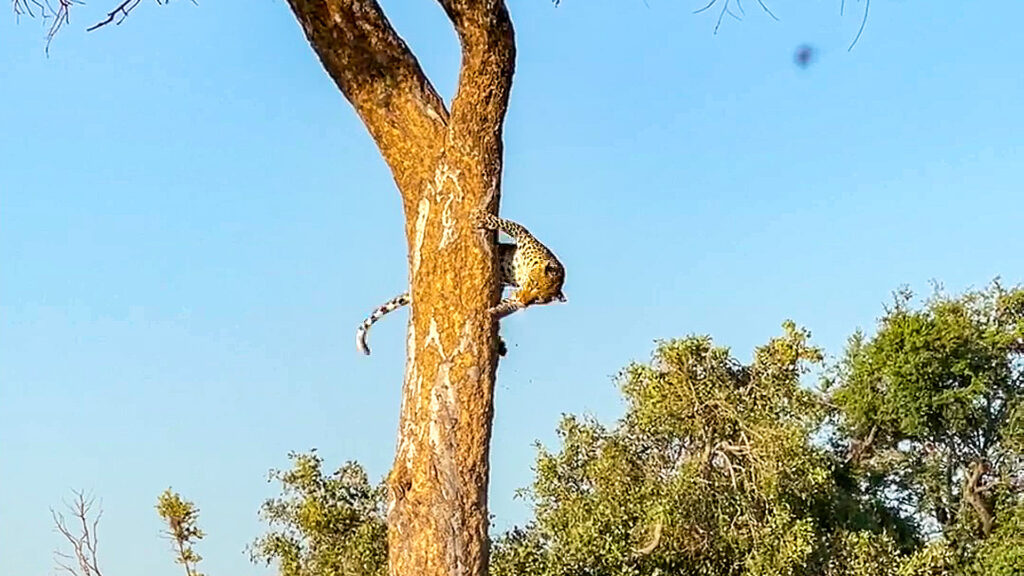
However, as it passes the point of no return, its hind legs lose their grip and gravity takes over. Consequently, its hindquarters come around too fast, thereby compromising its grip on the tree.
Adaptive reflexes
Now, leopards are nothing if not adaptable. And they are blessed with reflexes that would see most other creatures come crashing to Earth at this point.
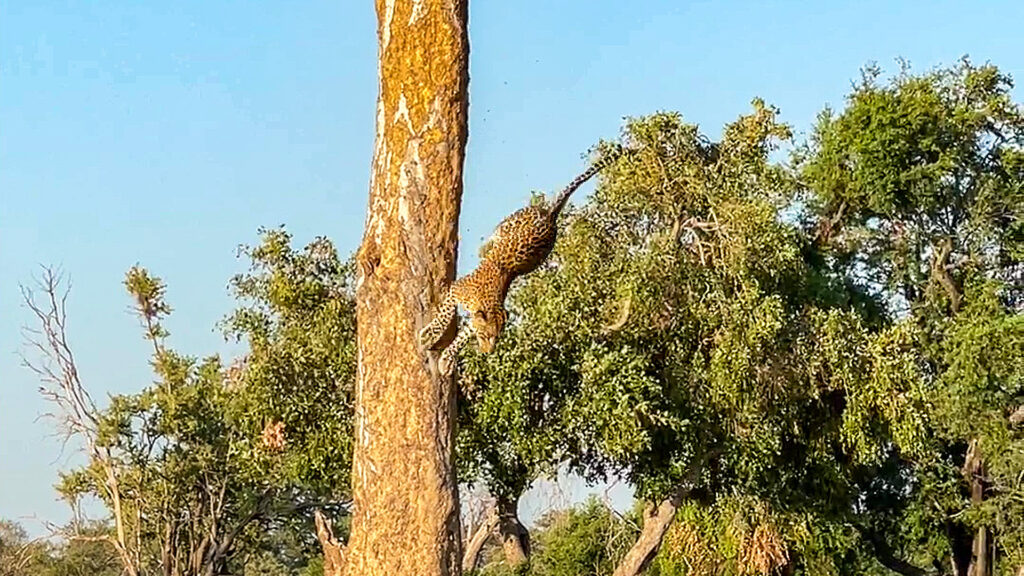
Barely clinging to the tree by its claw-tips, the spotted beauty uses what friction it has in preparing to leap. As it does, its eyes stay locked on the ground below.
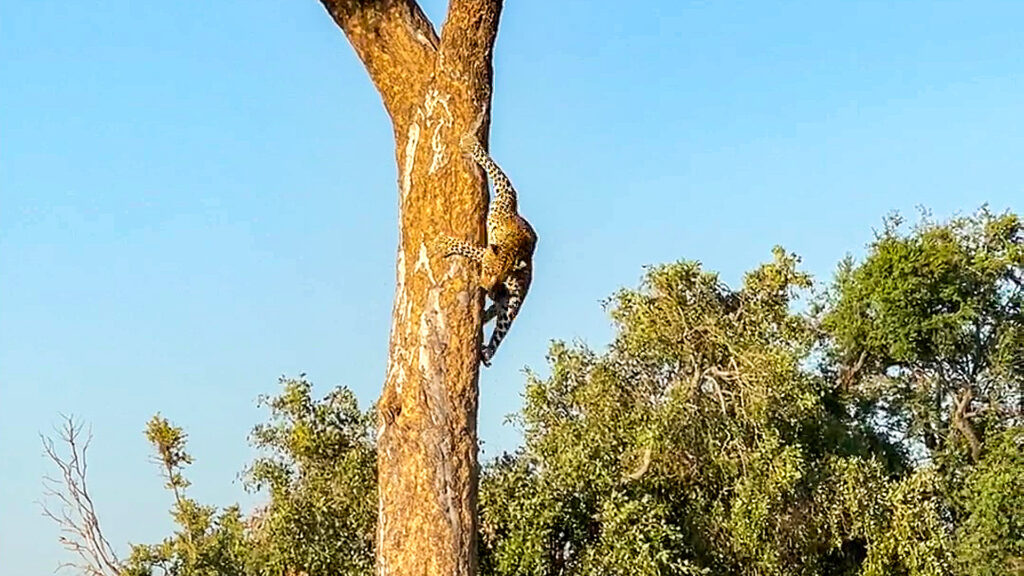
Then, with almost casual elegance, the cat lets go. Showing amazing acrobatic skills, it softly springs away from the trunk as it drops several metres to the ground.
Get our Best Sightings as they Come in
Typical cat
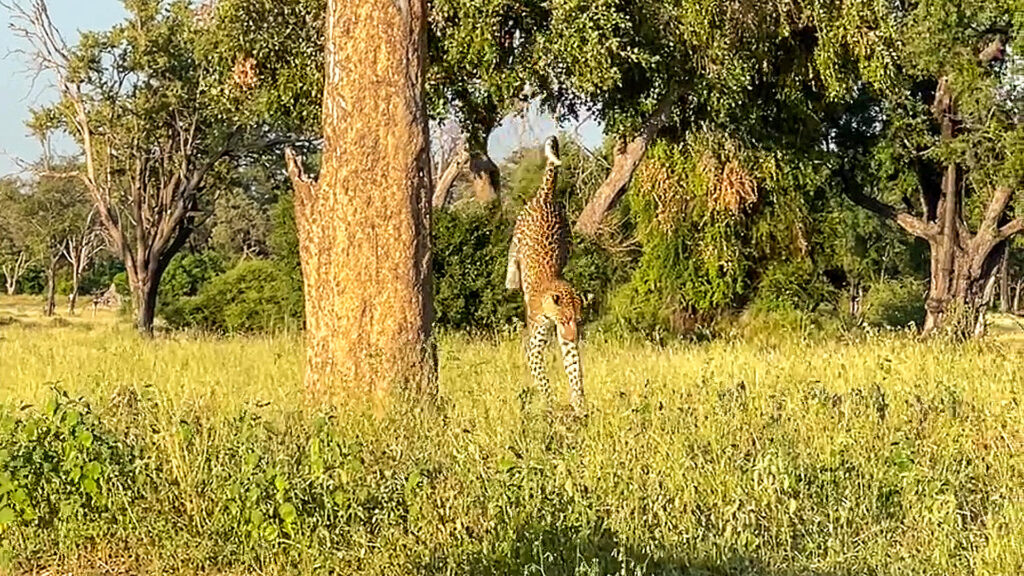
Then, in true cat fashion, it brings all four legs below it to cushion the impact from the fall. With barely a sound, it lands unharmed and seemingly unflustered.
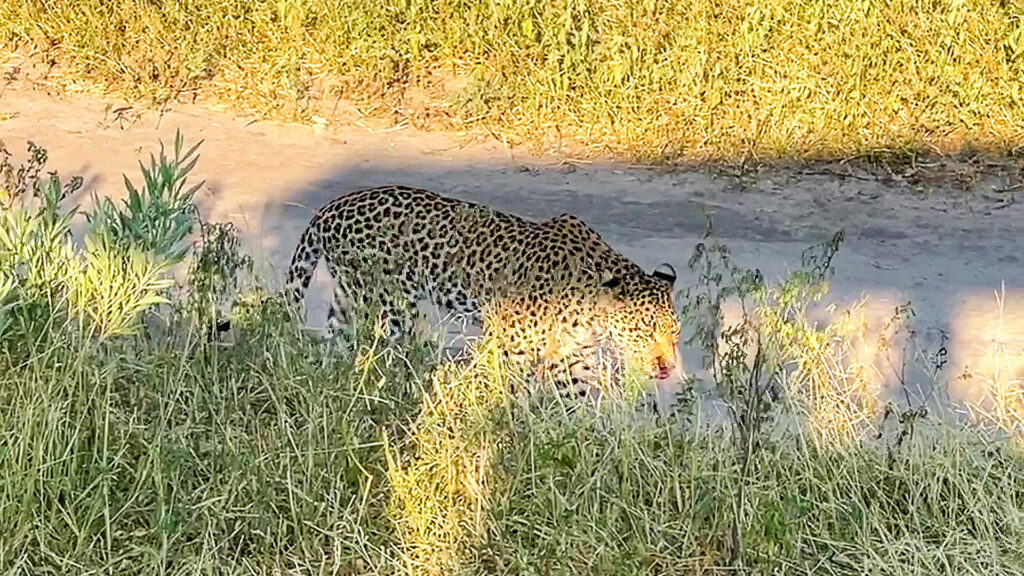
Emerging moments later from the long grass, you’d never have guessed the amazing feat it had just performed. But why, you may wonder, would leopards climb trees if coming down is so perilous?
Why climb trees?
A clue to the answer is in the image above. If you look carefully, there appears to be blood on its muzzle. This suggests that it had been feeding on something in the tree.
In order to protect their kills from scavengers, leopards routinely hoist them into trees for safekeeping. Additionally, these lofty heights are a great place to rest undisturbed and look for prey in the surrounding area.
Leopards are notoriously difficult to spot while on safari. A good place to start is by scanning any tall trees in the vicinity. With luck and patience, you may be rewarded with one of the most iconic sights in Africa.


