

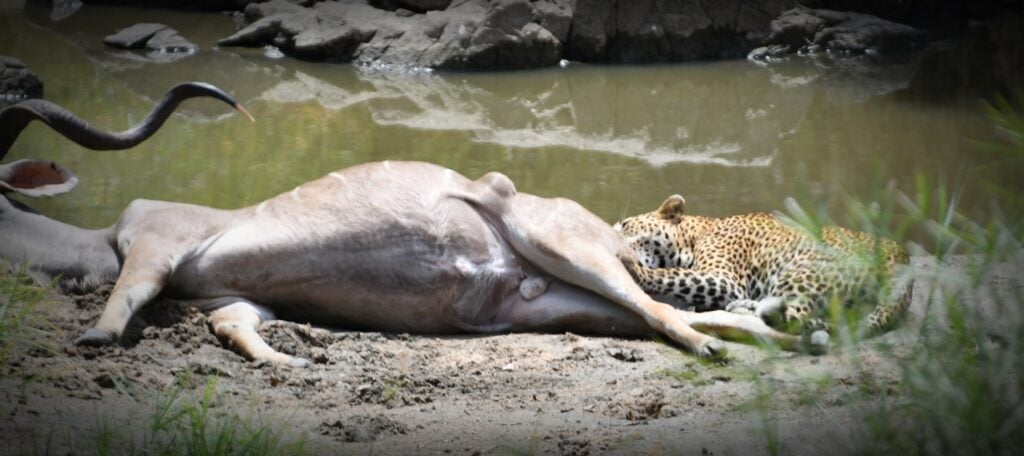
Gillian Soames submitted these images to Latest Sightings. She told us that she witnessed the incident from the Phelwana Bridge on the H7 between Satara and Orpen Camps in the Kruger National Park.
Something exciting up ahead
Gillian told us that she was alerted to the presence of something exciting when she saw some other tourists taking photos from their campervan.
Pulling up, she was amazed to see a leopard in the process of asphyxiating a full-grown kudu bull.
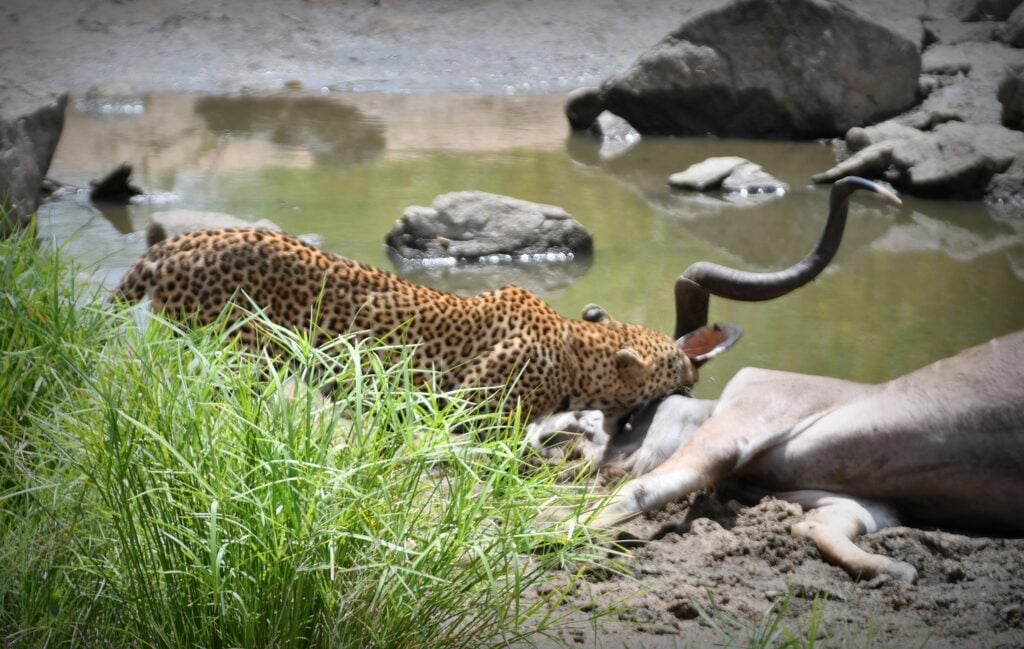
She said that at the time, the kudu’s legs were still twitching. This suggests that she had only just missed what must have been an epic battle.
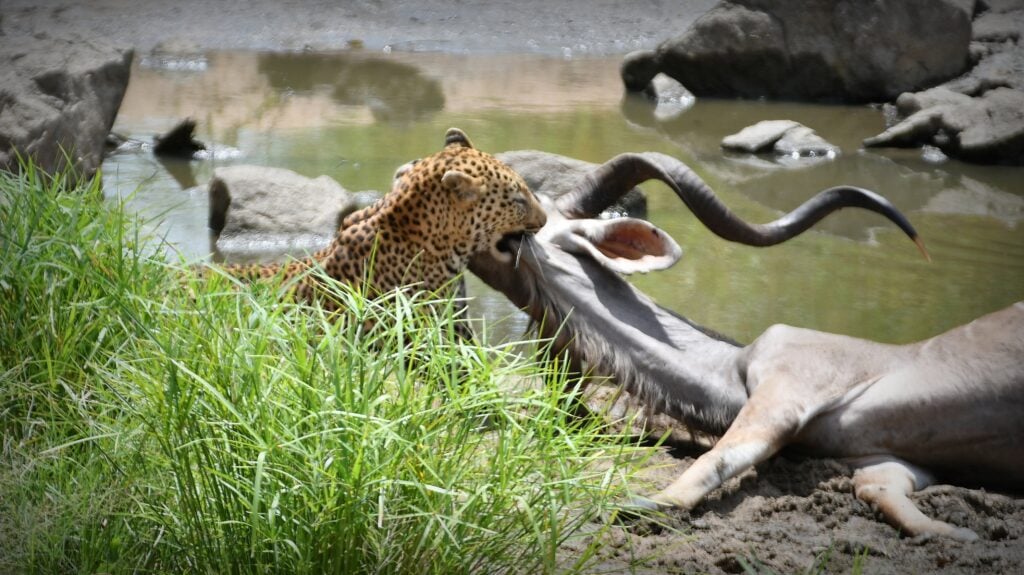
As can be seen, the size difference between predator and prey is substantial. A large male leopard might weigh as much as 90 kilograms. By comparison, a large kudu bull such as the one photographed could weigh up to 300 kg.
Size difference aside, it is clear that once the leopard sank its canines into the kudu’s throat, the antelope’s end followed shortly after.
Dinner’s ready
Having asphyxiated its prey, the leopard moved towards the antelope’s rear to begin feeding. Predators typically begin feeding in this area as it offers the easiest access to the prey’s innards.
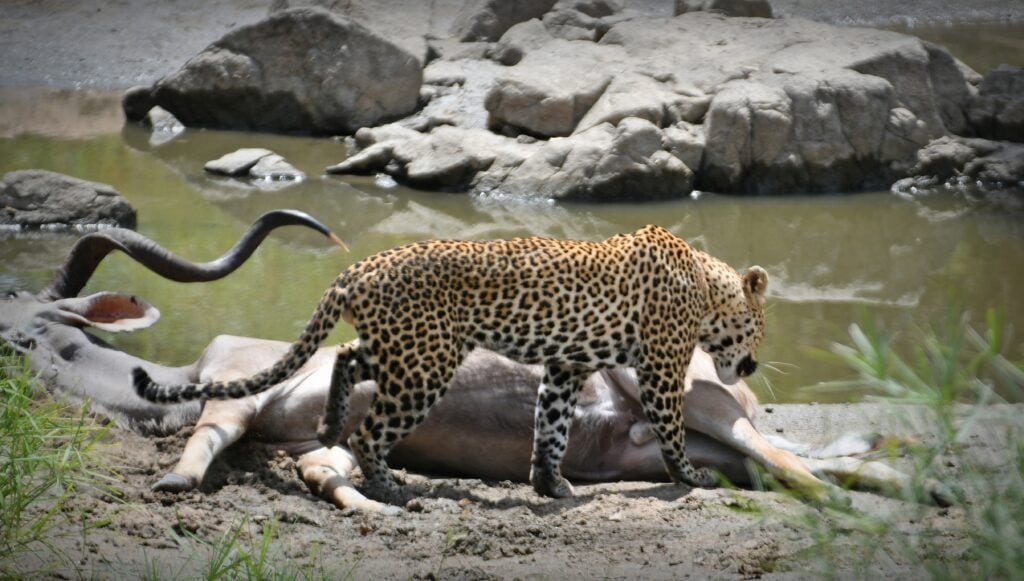
As it moves, we notice that this is a male leopard, although he looks quite young. This makes his feat of hunting even more impressive.
In situ dining
Needless to say, the kudu is too large for the leopard to attempt to hoist it up a tree, as it would with smaller prey.
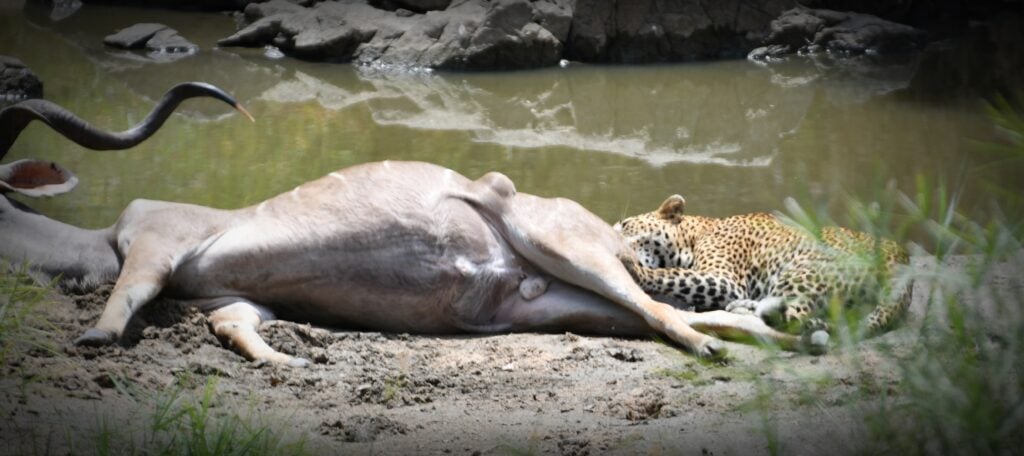
As such, it must feed where the kudu fell. For solitary predators like leopards, this means that there is a chance that they might lose their prize to other predators, such as lions or hyenas.
Still too heavy
After feeding for a while, the spotted beauty got up and sniffed around the head of its prey. Leopards will eat up to two kilograms of meat per sitting.
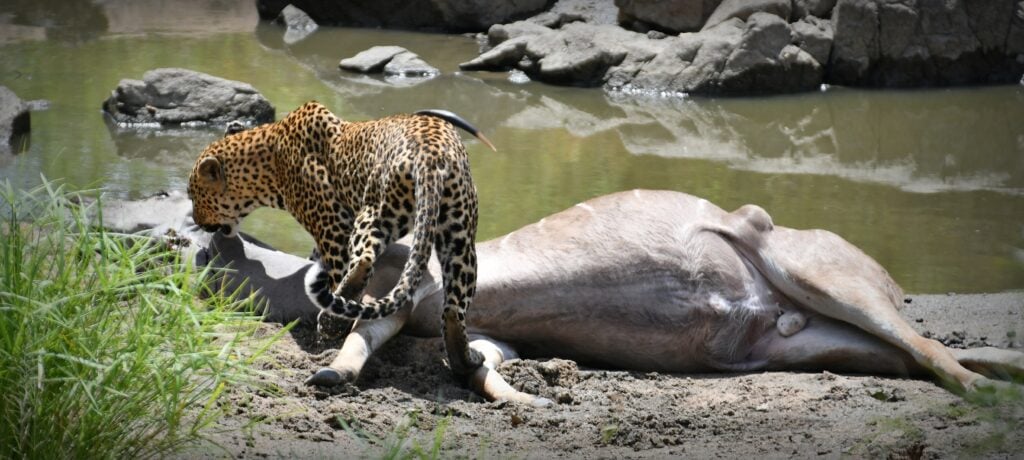
What happens next is curious. The leopard once again grabs the kudu by its throat. Perhaps it thought that it might now be able to drag the carcass away.
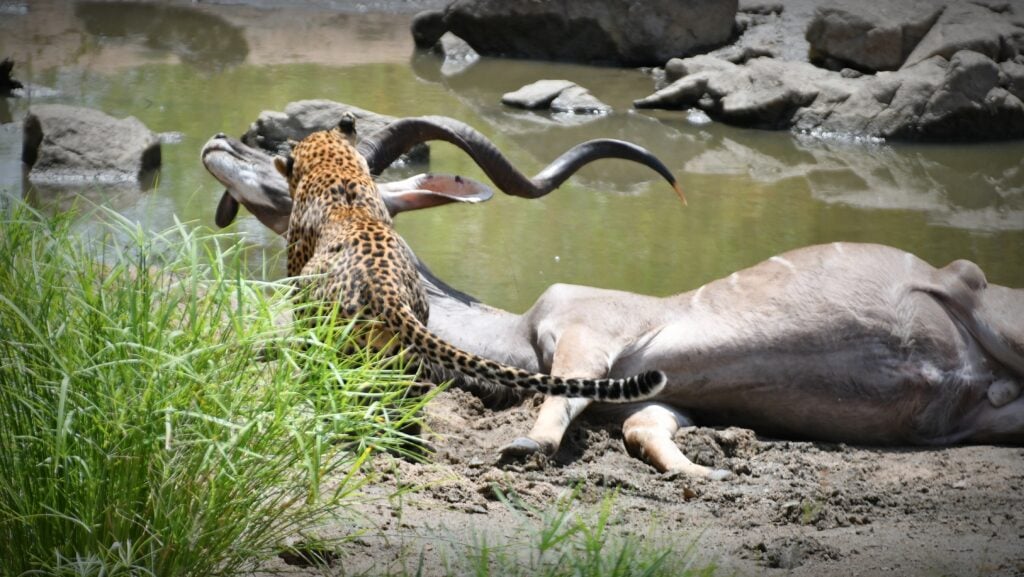
However, if that was the case, he soon realised that it was still far too heavy. The maximum estimated weight that a leopard could hoist up a tree is just over 100 kg.
Get our Best Sightings as they Come in
Spoilt for choice
And so, the leopard resigns itself to the fact that it will have to remain feeding where the kudu fell. Once again, he returns to the rear and begins feeding on the juicy flesh of its thigh.
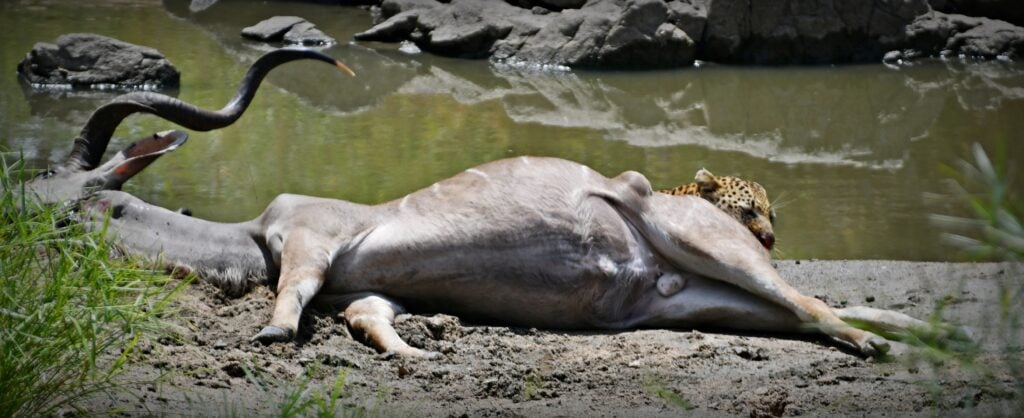
With smaller prey, leopards will often disembowel their prey to get at the nutritious organs like the liver and kidneys. However, in this case, he is happy to chomp on raw flesh for the time being.
Once in a lifetime sighting
Gillian said that she couldn’t stay with the leopard as she had a long way to travel that day.

However, she continued, “We live in the bush (Hoedspruit) and have been to the Kruger National Park over 400 times, but this is a first for [me] and, most certainly, a sighting of a lifetime.”


