

Few would argue that leopards are one of the most beautiful predators on Earth. Their distinctive spotted coats cover lithe, powerful bodies perfectly designed to hunt.
But when to hunt is an all-important question, even for these efficient assassins. In this video, we see that even the most well-thought-out plan is no guarantee of success.
Resting princess
As the video begins, we are graced with a beautiful sight. A female leopard is on the alert. Crouched behind a fallen log, her piercing gaze has spotted something of interest.

Typically, leopards do most of their hunting at night. However, their excellent camouflage means that they also enjoy considerable success hunting during the day.
Leopards have one of the most varied diets of all the big cats. They’ve been recorded hunting everything from insects to a 900-kg eland bull.
Typical prey
However, in the next scene, we see that she has her eye on one of her most common prey species: impalas.

Meanwhile, short distance away, a bachelor herd of impala rams is grazing peacefully, unaware of the leopard’s presence.
Stretch and go
Consequently, despite it being daytime, it seems the leopard fancies her chances. So, after a brief stretch, she rises to stalk the impalas.

As leopards are not built for long-distance chases, their hunting strategy is to stalk as close as possible before launching their assault. To achieve this, they rely on camouflage, stealth, and a well-thought-out approach.

As she passes within metres of the camera, we can see that her focus is absolute. In seconds, she has gone from a passive observer to a determined killer.
Gradual approach
As she moves closer to her intended targets, she uses the terrain to her advantage. Not wanting to alarm the impalas, she stops at intervals to observe their behaviour and refine her approach strategy.

When hunting, experienced leopards understand that charging straight at their prey is bound to fail. They also know that the most careful approach is no guarantee of success. As such, they are infinitely patient.
Available cover
Subsequently, after observing the impala for a short while, she makes her next move. Using the ridge between them to hide her progress, she makes her way towards a thicket that will provide more cover as she gets closer.

At this point, while she must be patient, she also knows she can’t delay too long. The last thing she wants is for the herd to start moving away before she is in position to ambush them.
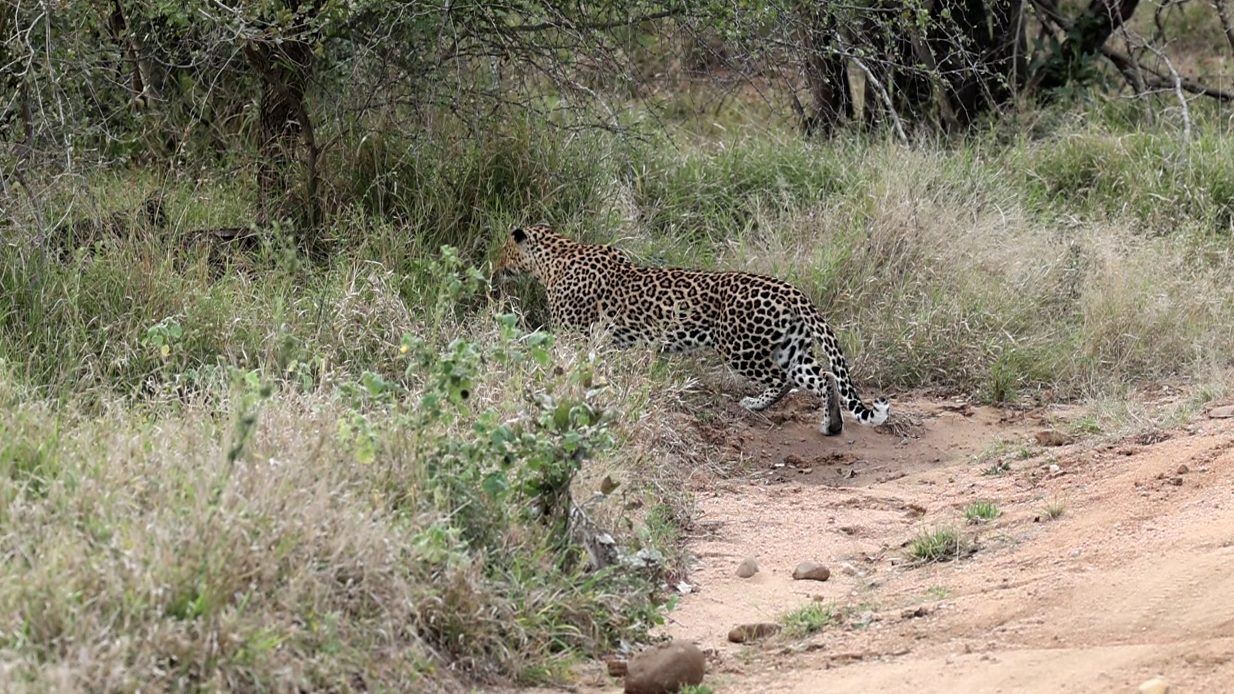
As she reaches the thicket, she pauses again. Sensing that something may be concealed in the dense bush, she takes care not to raise the alarm.
The impalas, meanwhile, remain unaware of her presence, and we hear the guide comment that he thinks she has a very good chance of making a kill.
Get our Best Sightings as they Come in
Not to be
However, in the next scene, we see the impalas scatter as their snorting alarm calls punctuate the air. Unfortunately, we don’t know what caused them to run.

Like most prey species, impalas are skittish by nature, with even the slightest scent or sound causing alarm. After all, it is better to be safe than sorry.
Oh well, better luck next time
When the camera pans back to the leopard, we see she has abandoned her attempt. Curiously, we then see her vocalising in the distinctive coughing way of leopards.
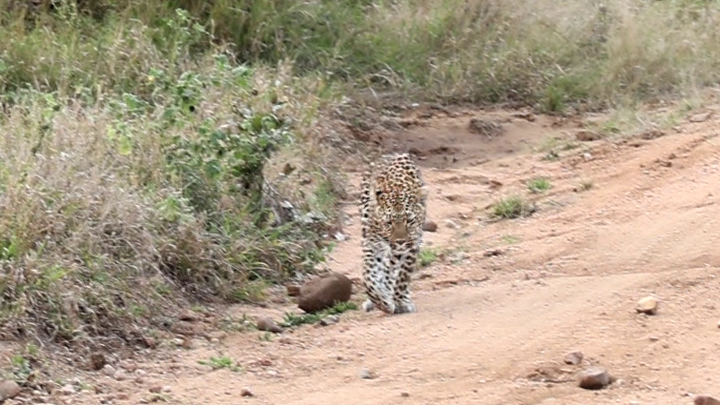
Whether this is in frustration, as one observer suggests, is uncertain. What we can be sure of is that this will not deter her from trying again soon. Better luck next time!


